
What It Really Costs to Employ Someone in India Through an EOR
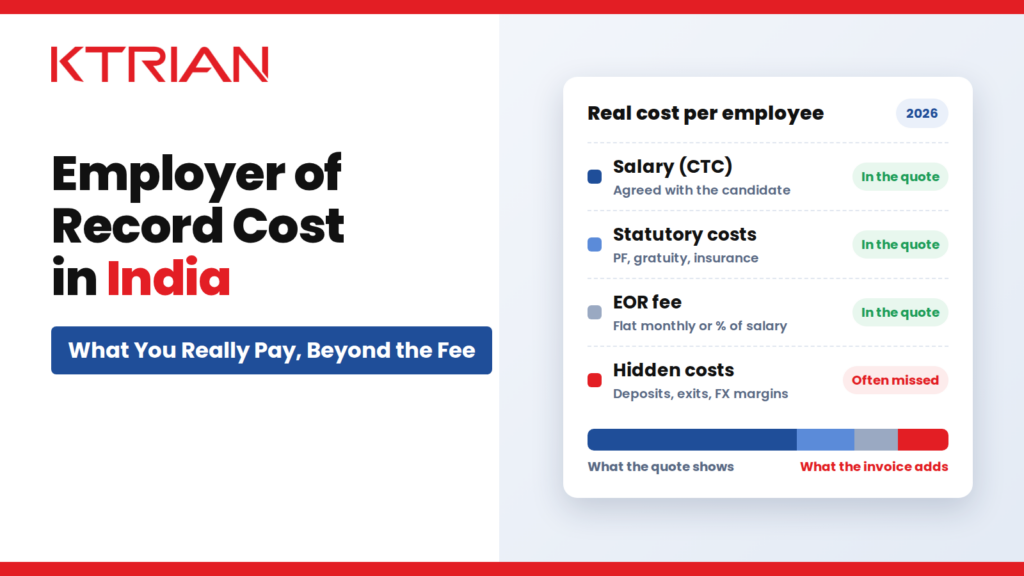
The cost of hiring an employee in India through an employer of record has three components: the agreed salary, the statutory contributions required by Indian law, and the provider’s service fee. Service fees typically range from about $100 to $800 per employee per month, although some providers charge a percentage of salary instead.
In practice, budgets are rarely affected by the service fee itself. Variances usually come from how the salary is defined, how provident fund is calculated, and charges outside the headline price. This guide addresses each, using 2026 rates and a sample calculation.
Key points
- Salaries in India are agreed on a CTC (cost to company) basis, which typically includes employer provident fund and gratuity.
- Employer provident fund is 12% of basic wages, subject to a statutory wage ceiling of ₹25,000 per month since 17 September 2026.
- EOR fees are structured as a flat monthly amount per employee or as a percentage of salary.
- Deposits, setup charges and currency margins are often excluded from the quoted fee.
The three components of EOR cost
Component | What it includes | Determined by |
Salary (CTC) | Basic pay, allowances and, typically, employer PF and gratuity | You and the candidate |
Statutory and benefit costs | Provident fund, gratuity, ESI where applicable, health insurance | Indian law and market practice |
EOR service fee | Payroll and compliance, plus sourcing and onboarding with a managed EOR | The provider |
Understanding CTC before you make an offer
Candidates in India evaluate offers on CTC, or cost to company: the total annual cost of employment. CTC includes basic pay, allowances and the employer’s provident fund contribution, and frequently gratuity and insurance. Net take-home pay is considerably lower.
Most budget variances originate here. Before an offer is issued, confirm the basis of the salary figure:
- Agreed on CTC: employer contributions are already included. The CTC represents your salary cost.
- Agreed on gross or net pay: employer contributions are added on top.
A reliable EOR will present both versions side by side before the offer is released.
Statutory employer costs in India: 2026 rates
Item | Employer cost | Applies to | Notes |
Provident fund (PF) | 12% of basic wages | Most employees | Wage ceiling of ₹25,000 per month from 17 September 2026, a maximum of ₹3,000 per month when calculated on the ceiling |
Gratuity | Approximately 4.81% of basic pay, accrued annually | Permanent employees after 5 years, fixed-term after 1 year | Equal to 15 days of basic pay for each year of service |
Employees State Insurance (ESI) | 3.25% of gross wages | Employees earning up to ₹21,000 per month | Rarely applicable to professional roles |
Statutory bonus | 8.33% to 20% of wages | Lower salary bands | Rarely applicable to professional roles |
Professional tax | Up to ₹2,500 per year | Varies by state | Deducted from the employee’s salary |
Health insurance | Varies by policy | Not mandatory outside ESI | Expected by most candidates |
The labour codes also require basic pay and related components to represent at least 50% of total compensation. This increases the base for provident fund and gratuity, so any quote with an unusually low basic salary should be reviewed carefully.
How EOR providers structure their fees
Pricing model | Typical range | Best suited to |
Flat fee per employee per month | Approximately $100 to $800 | Mid-level and senior roles, fixed budgets |
Percentage of salary | Approximately 8% to 20% | Junior roles |
Two providers quoting the same fee may offer very different levels of service. One may limit its scope to payroll and compliance, while another includes sourcing, screening and onboarding.
Costs outside the headline fee
Charge | Question to ask |
Security deposit | How many months are required, and when is it refunded? |
Setup fee | Is there a one-time charge per new hire? |
Exit fee | Is a fee charged when an employee leaves? |
Currency conversion | Which exchange rate applies, and what margin is added? |
Benefits administration | Is insurance billed separately? |
Contract amendments | Are salary revisions or role changes charged? |
Sample calculation: senior software engineer at ₹18 lakh (₹1.8 million) CTC
This example assumes basic pay at 50% of CTC. Actual figures depend on the salary structure, benefits and provider.
Line item | Annual amount | Basis |
Agreed CTC | ₹18,00,000 | Basic pay of ₹9,00,000 |
Employer PF | Included in CTC | ₹36,000 on the ₹25,000 ceiling, or ₹1,08,000 on full basic pay |
Gratuity provision | Included in CTC | Approximately ₹43,290 (4.81% of basic pay) |
Health insurance | Varies by policy | Included in CTC or added separately, per the offer |
EOR service fee | Monthly fee × 12 | Depends on scope of service |
When the salary is agreed on a CTC basis and the EOR quotes against the same CTC, monthly invoices remain predictable.
EOR vs establishing your own entity
Employer of record | Own Indian entity | |
Time to first hire | Days | Several months |
Upfront investment | None, or a modest setup fee | Incorporation, legal and registration costs |
Ongoing overhead | Per-employee fee only | Accounting, company secretarial, audit, payroll and HR |
Best suited to | New or growing India teams | Large, long-term India operations |
For a small team, an EOR is almost always more cost-effective because there is no entity to maintain. As headcount grows and the team becomes permanent, the economics may shift in favor of your own entity.
Standard vs managed EOR: what the fee covers
With a standard EOR, your team sources and screens candidates, and the provider takes over once an offer is made. A managed EOR also covers sourcing, screening, interview support and onboarding. The most accurate comparison is the total cost of placing a productive employee in the role, not the monthly fee in isolation.
Seven questions to ask before signing
- Is the quote based on CTC, gross or net salary?
- Is provident fund calculated on the ₹25,000 ceiling or on full basic pay?
- How are salaries structured under the 50% wage rule?
- What security deposit is required, and when is it refunded?
- Are there setup, exit or contract amendment fees?
- Which exchange rate and margin apply to payments?
- Beyond payroll and compliance, what does the fee include?
Frequently asked questions
What does an employer of record cost in India? The employee’s salary and statutory contributions, plus the EOR service fee. The fee is usually a flat monthly amount of about $100 to $800 per employee, or a percentage of salary.
What statutory costs does an employer pay in India? Primarily the 12% provident fund contribution and gratuity. ESI and statutory bonus apply only at lower salary levels. Health insurance is not mandatory outside ESI, but most candidates expect it.
What is the provident fund wage ceiling in 2026? ₹25,000 per month, effective 17 September 2026, up from ₹15,000.
Is CTC the same as take-home salary? No. CTC is the employer’s total annual cost, including provident fund. Take-home pay is lower.
Is an EOR more cost-effective than setting up a company in India? For a small team, yes, as there is no entity to maintain. For a large, long-term team, your own entity may cost less.
Closing (call to action)
KTRIAN is a managed employer of record in India, backed by more than 15 years of experience in talent acquisition. We manage the complete hiring lifecycle: sourcing, screening, interview support and onboarding, followed by employment, payroll and compliance from day one. Every engagement starts with a clear, itemized cost breakdown for each role. Request a cost breakdown for your first India hire.