
How to Hire Employees in India Without an Entity
Last updated: 23 October 2026
Can you hire employees in India without an entity?
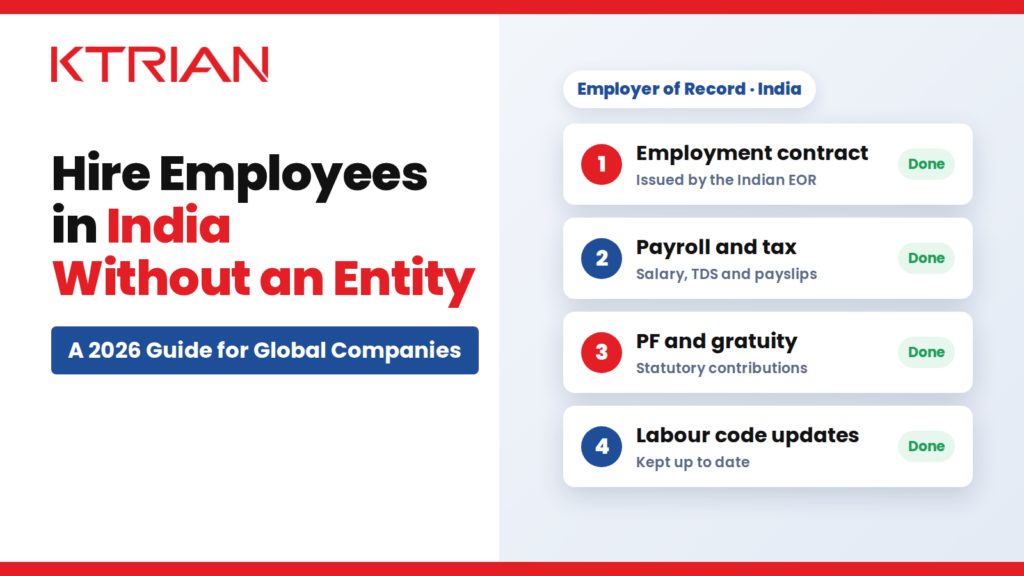
Yes. A global company can hire full-time employees in India without setting up its own Indian company by using an employer of record (EOR). The EOR’s Indian entity becomes the legal employer and handles contracts, payroll, tax and statutory benefits, while you direct the work and lead the team.
In this guide
- Three ways to employ talent in India
- How the employer of record model works
- Is the EOR model legal in India?
- Compliance obligations in 2026
- Hiring timelines to plan for
- Standard EOR vs managed EOR
- Choosing an enterprise-grade EOR partner
- When to establish your own entity
- Checklist before extending an offer
- Frequently asked questions
Building a team in India no longer requires a local subsidiary. Most international companies make their first India hires through an employer of record (EOR): an Indian company that serves as the legal employer, administers payroll, tax and statutory filings, and leaves day-to-day direction of the work entirely with you.
This guide sets out the options available to a foreign employer, how the EOR model operates in practice, the compliance obligations that apply in 2026, and the point at which establishing your own entity becomes the better investment.
For a full view of what goes into the cost, see our guide to what an employer of record costs in India.
Notice periods in India are longer than many international employers expect. Maintaining regular contact with the candidate throughout this period significantly reduces the risk of a late counter-offer.
A standard EOR is appropriate when you already have recruitment capability and HR expertise in India. A managed EOR is better suited to organizations entering India for the first time, as it provides a single partner accountable for the entire process, from sourcing to payroll.
Key points
- An EOR allows a company with no Indian entity to employ full-time staff in India lawfully.
- Hiring decisions, management and compensation reviews remain with your leadership.
- Employment contracts, payroll, tax withholding and statutory contributions are handled by the EOR.
- Onboarding paperwork is completed within days. The candidate’s notice period, typically 30 to 90 days, determines the start date.
Three ways to employ talent in India from overseas
| Model | Legal employer | Time to first hire | Statutory benefits | Compliance exposure | Best suited to |
| Employer of record | An Indian EOR entity | Days | Included | Low, held by the EOR | New or growing India teams |
| Independent contractor | None | Immediate | Not included | High for full-time roles | Defined, short-term projects |
| Own subsidiary | Your Indian company | Several months | Included | Held by you | Large, established teams |
Employer of record (EOR)
The EOR assumes the legal and administrative responsibilities of employment. Your organisation retains full control over the work, priorities and performance. It is the fastest route to a fully compliant, full-time team in India.Independent contractors
Contractor agreements suit project-based engagements. Where a contractor works full time, exclusively for one company and under its direction, Indian authorities may treat the relationship as employment, regardless of how the contract is worded. Contractors also receive no provident fund, gratuity or insurance, which weakens retention.Own subsidiary
A subsidiary offers complete control, but requires incorporation, a resident director, a local bank account, multiple statutory registrations and ongoing annual compliance.Planning your first hires in India? Talk to our team about the right setup for your roles.
How the employer of record model works
- Your team selects the candidate and approves the compensation package and start date.
- The EOR issues the offer letter and employment contract through its Indian entity, structuring the salary in line with Indian law.
- From the first month, the EOR runs payroll, withholds income tax (known in India as tax deducted at source, or TDS) and remits provident fund and other statutory contributions.
- You receive a single consolidated invoice covering salary, statutory costs and the EOR’s service fee.
- The employee works as part of your team, on your systems, in your meetings and against your objectives.
| Your organization | The EOR |
| Final hiring decision | Offer letter, employment contract and appointment letter |
| Day-to-day management and goals | Monthly payroll and payslips |
| Performance reviews and promotions | Tax withholding and filings |
| Decisions on separation | Provident fund, gratuity and other statutory contributions |
| Leave approvals and workplace policies | Ongoing compliance with labour law changes |
Is the employer of record model legal in India?
Yes. The EOR is a registered Indian employer, so your hire is a regular employee under Indian law, entitled to the same rights and benefits as any other employee in the country. The arrangement remains compliant provided the EOR maintains its registrations and meets its filing obligations. As part of due diligence, request three documents from any provider: proof of statutory registrations, a sample employment contract and a sample payslip. One area requires separate advice. If an India-based employee will negotiate or sign contracts on behalf of your company, consult a tax adviser, as this activity may create a taxable presence in India. Roles in engineering, finance, recruitment and operations rarely raise this concern.Compliance obligations in 2026
- Appointment letter. Mandatory for every employee, setting out role, compensation and terms of employment.
- Provident fund (PF). The employer contributes 12% of basic wages. The statutory wage ceiling increased from ₹15,000 to ₹25,000 per month on 17 September 2026.
- Employees State Insurance (ESI). Applies to employees earning up to ₹21,000 per month, so most professional roles fall outside its scope.
- Gratuity. Payable after five years of service for permanent employees, and after one year for fixed-term employees.
- Income tax withholding. Deducted from salary each month, with periodic returns filed by the employer.
Hiring timelines to plan for
| Stage | Typical duration |
| Sourcing and screening | 2 to 4 weeks |
| Offer, contract and onboarding | A few days |
| Notice period with current employer | 30 to 90 days for experienced professionals |
Standard EOR vs managed EOR
A standard EOR employs the people you have already found. A managed EOR also finds them. KTRIAN sources and screens candidates for your roles, supports your interviews, then onboards, employs, pays and supports every hire. You get one partner and one point of accountability, from the first search to every payday.HOW KTRIAN’S MANAGED EOR WORKS
One partner, from first search to every payday
FIND AND HIRE
1
Source
We search India’s talent hubs against your brief.
2
Screen
Only strong, relevant candidates reach your shortlist.
3
Interview support
We schedule, coordinate and share structured feedback.
EMPLOY AND SUPPORT
4
Onboard
Offer, contract and day-one setup, handled end to end.
5
Employ and pay
Payroll, PF, gratuity and statutory filings, every month.
6
Ongoing support
HR support for your team as it grows.
Standard EOR starts at step 4. KTRIAN’s managed EOR covers all six steps, with one team accountable to you.
| Standard EOR | Managed EOR | |
| Candidate sourcing | Your team | The EOR |
| Screening and interview support | Your team | The EOR |
| Contract, payroll and compliance | The EOR | The EOR |
| Onboarding | Shared | The EOR |
| Post-hire support | Limited | Ongoing |
See how a Managed EOR in India works with KTRIAN.
What to expect from an enterprise-grade EOR partner
- A single point of contact accountable for your India team
- Transparent, itemized invoicing with no unexplained charges
- Employment contracts and salary structures aligned with the labour codes
- Documented onboarding and exit processes
- Handling of employee data in line with India’s Digital Personal Data Protection Act
- Support for transferring employees to your own entity when you are ready
When to establish your own entity
A subsidiary becomes worth evaluating when the India team is large and permanent, and you require a local office, local leadership and your own HR policies. Many organizations begin with an EOR, validate the team’s performance, and later transfer employees to their own entity. Confirm before signing that your EOR supports this transition.Checklist before extending an offer
- Confirm the role is full time and long term. If so, avoid a contractor arrangement.
- Present compensation as CTC (cost to company), the standard basis on which candidates in India evaluate offers.
- Define benefits beyond the statutory minimum, particularly health insurance.
- Review the EOR’s registrations, a sample contract and a sample payslip.
- Clarify the process for resignations, notice periods and final settlement.
- Align the start date with the candidate’s notice period.